
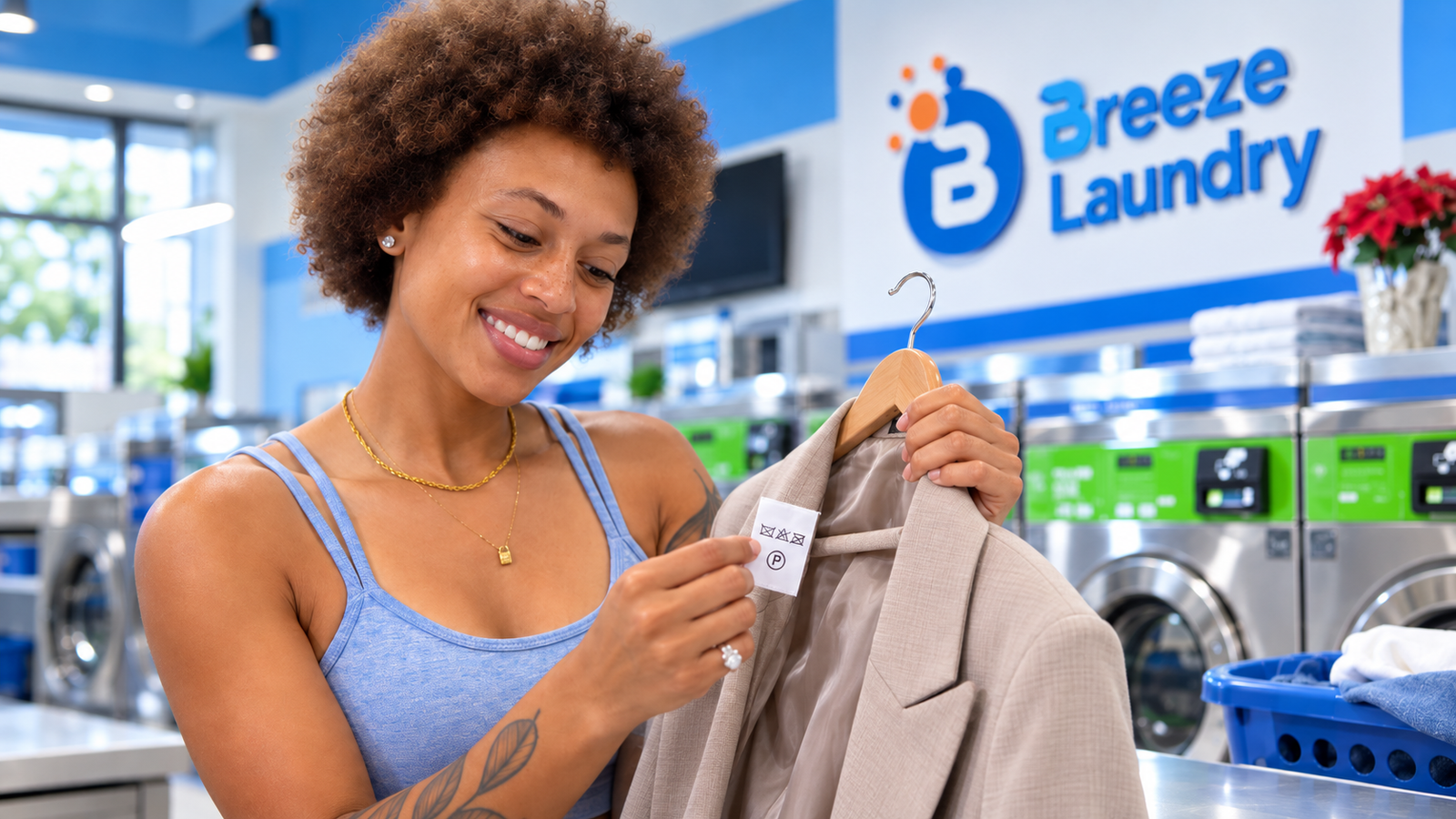
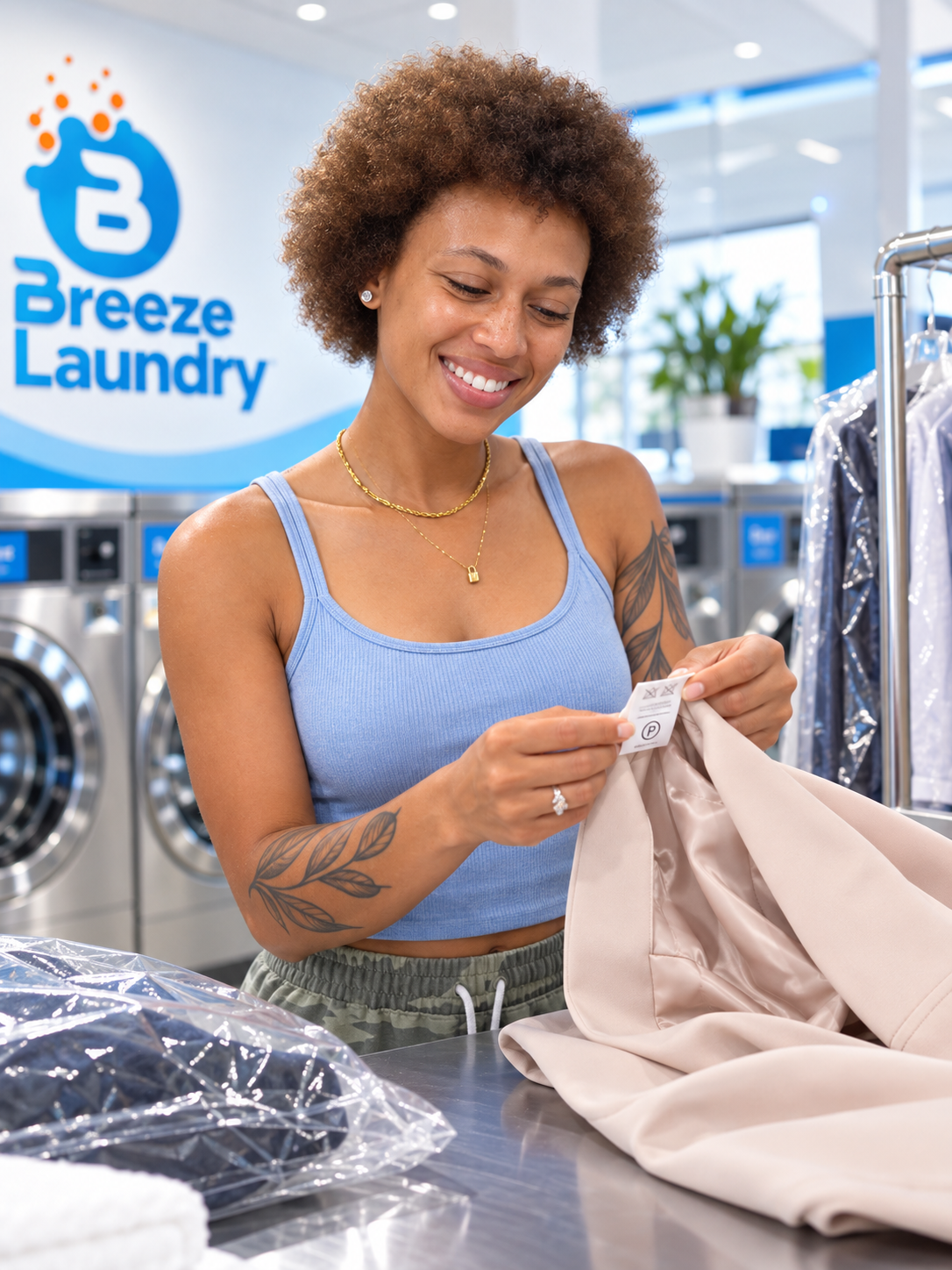
A Dry Clean Only label is a warning against washing the garment. If you want to follow the manufacturer’s care instructions, do not put that item into a normal wash cycle just because the fabric looks familiar.
The reason may involve the fabric, but it can also involve dye, lining, trim, interfacing, buttons or the way the garment is built. Start by reading the entire care label instead of guessing from the material. Read the entire care label.
For Houston customers, Breeze Laundry Westheimer offers professional garment care when an item calls for dry cleaning. Everyday machine washable clothes belong in a different service path.
Have a garment labeled Dry Clean Only? Explore Dry Cleaning at Breeze Laundry Westheimer before deciding how to clean it.
Quick Answer: What Does Dry Clean Only Mean?
Under the Federal Trade Commission care labeling framework, the word Only matters.
The FTC Care Labeling Rule guidance says manufacturers and importers covered by the rule need a reasonable basis for the care instructions they provide. A Dryclean Only warning should be used only when there is evidence that washing will damage the garment.
That does not tell you exactly what type of damage would occur. It tells you that washing is not the supported care method for the finished item.
Read the Label in This Order
You do not need to memorize every laundry symbol before you can make a sensible decision. Use a simple reading order.
1. Look for the Written Care Instruction
Start with the clearest words on the tag. If it says Dry Clean Only, do not treat the item like ordinary washable clothing. A label that says Dry Clean without Only identifies dry cleaning as a supported method, but it does not carry the same warning against washing.
2. Check Whether Washing Is Allowed
Look for a washing instruction or a crossed out wash symbol. If the label does not allow washing, do not let the appearance of the fabric override the instruction.
3. Read the Drying and Ironing Instructions
A safe wash is only part of garment care. Drying and heat can also affect shape, finish and trim. Read those instructions before deciding that an item can go through your normal laundry routine.
4. Notice Professional Care Symbols
A circle is commonly used for professional textile care. You do not need to decode every variation yourself, but the symbol is a useful signal that the garment may need a professional process.
5. Consider the Whole Garment
A care label applies to the finished item, not only the main fiber. A jacket may have washable outer fabric but also contain lining, shaping material, trim or adhesives that respond differently to water and movement.
What Is the Difference Between Dry Clean and Dry Clean Only?
These instructions are easy to confuse because they look almost identical.
- Dry Clean tells you that dry cleaning is a supported care method.
- Adding Only creates a warning against washing.
- A washable item may have separate instructions for cycle, temperature, drying and ironing.
The important point is not to invent a second safe method from the fabric name alone. A plain Dry Clean instruction does not automatically prove that home washing is safe, and a Dry Clean Only warning should not be treated as casual advice.
Why Can a Garment Need Professional Care?
Sometimes the concern is the fabric. Other times it is the construction.
The American Cleaning Institute notes that washing can affect buttons or trim, cause dyes to run, or create shrinkage concerns. Those are examples of why a garment that looks simple from the outside may still carry a professional care instruction.
Think about the item as a system. The outer material, lining, color, seams, trim and structure all need to come through cleaning together.
That is why two garments with similar fiber content can have different labels.
Can You Wash a Garment With This Warning at Home?
If you want to follow the care label, do not wash it at home.
A delicate cycle or hand wash may reduce agitation, but it does not remove the garment’s exposure to water. If the risk involves unstable dye, residual shrinkage, bonded construction or trim, a gentler wash may still create a problem.
The American Cleaning Institute notes that someone who chooses to wash against a professional care warning is accepting that risk themselves.
For a garment you value, the practical decision is to follow the label rather than use the item as a test.
What If the Label Is Missing or Hard to Read?
Do not replace missing information with a broad fabric rule.
If the tag is faded, cut out or confusing, look at the whole garment before cleaning it. Structured tailoring, lining, decorative trim and mixed materials are all reasons to be cautious.
When the correct route is unclear, professional review is more useful than assuming that every cotton, wool, silk or synthetic garment should be handled the same way.
What If You Already Washed the Garment?
First, stop and inspect it before doing anything else.
Check the size, shape, color, surface, lining and trim. If something has changed, avoid adding more heat, stain remover or repeated washing in an attempt to fix it.
A professional cleaner may be able to assess the garment, but no cleaner can promise that every type of wash damage can be reversed.
Which Items Belong in Wash & Fold Instead?
Dry cleaning and everyday laundry solve different problems.
Wash & Fold is a better fit for eligible clothing and household laundry that can follow normal machine washing and drying instructions. Professional Dry Cleaning is the better route when the care label or garment construction calls for it.
If you are sorting one large laundry bag, separate specialty care pieces before the rest of the load is handed over.
What If Convenience Is the Main Problem?
Choosing the correct care method does not mean you always need to make a separate trip.
Breeze offers Pickup & Delivery in eligible service areas. Use the live address checker to see what is available for your location, then make sure specialty garments are assigned to the appropriate service rather than mixed into ordinary washable laundry.
A Simple Care Label Decision Checklist
Before cleaning an unfamiliar garment, use this quick check:
- Read the written instruction before looking only at the fiber content.
- Check whether washing is allowed.
- Review drying and ironing directions as well as washing.
- Look for professional care symbols.
- Consider lining, trim, structure and mixed materials.
- Keep professional care items separate from normal washable loads.
- If the instruction is unclear, ask before cleaning the garment.
Professional Garment Care at Breeze Laundry Westheimer
Breeze Laundry Westheimer is located at 13711 Westheimer Rd Ste F, Houston, TX 77077 and is open daily from 5:00 AM to 12:00 AM.
If a garment calls for professional care, review the current Dry Cleaning options before your visit. Coming to the store? Get directions to Breeze Laundry Westheimer on Google Maps.
The Bottom Line
A Dry Clean Only label is there to stop you from treating the garment like routine washable laundry.
Read the full care label, pay attention to the word Only, and make the decision based on the finished garment rather than the fabric name alone. If washing is specifically warned against, professional care is the lower risk choice.
For everyday washable loads, use the service that fits those care instructions. Specialty garments should follow the professional care instruction instead.
Frequently Asked Questions
What Does Dry Clean Only Mean on a Clothing Label?
It means washing is specifically warned against for that finished garment. The safest way to follow the label is to use the professional care method it specifies.
Is Dry Clean the Same as Dry Clean Only?
No. Dry Clean identifies dry cleaning as a supported method. The version with Only goes further by warning against washing.
Can I Hand Wash a Garment Marked Dry Clean Only?
Hand washing still exposes the garment to water. A gentler process does not automatically remove the reason the manufacturer warned against washing.
What Does the Circle on a Care Label Mean?
A circle is commonly used for professional textile care. The complete label should be read together rather than relying on one symbol by itself.
Why Do Similar Fabrics Sometimes Have Different Care Labels?
The complete garments may use different dyes, linings, trim, finishes, adhesives or construction. Care instructions apply to the finished item, not just the main fiber.

One Comment